
Environmental Science
Practical File
%20Practical%20File%20in%20English%20Medium.webp "Nios Class 12th Environmental Science (333) Practical File in English Medium")
PDF is Paid
Note:- If you want Solved Practical PDF and Handwritten Practical Click On WhatsApp Button
Exercise - 1
Aim:- STUDY OF A SIMPLE ECOSYSTEM (SUGGESTED HABITATS: POND, RIVER, ESTUARINE, GRASSLAND, FOREST AND DESERT) AND DESCRIPTION OF THE BIOTIC AND ABIOTIC COMPONENTS OF THE ECOSYSTEM.
An ecosystem is a self sustaining and self regulating system in which living organisms interact with each other and with their environment. A pond is a good example of an aquatic ecosystem. The study of pond ecosystem is a very simple means to under-stand how various organisms are related to each other and their interdependence.
Objectives
After performing this exercise, you will able to:
- acquire the skill of making detailed observations of any eco-system and specially the pond ecosystem.
- identify and classify the biotic and abiotic components of the ecosystem;
- study the effects of abiotic (physical) components on the biotic(living) components;
- identify and list the various plants and animals that live in the pond.


METHOD
I. To study physical components of a pond
- The physical or abiotic components includes temperature, light intensity, pH of water, dissolved gases (oxygen and carbon dioxide).
- To study pH value of water.
- Collect water from the pond at midday when the sun in bright and rate of photosynthesis of aquatic plants at its maximum
- Divide the sample into two parts. Put one part of the sample in a dark place in a closed container for 24 hours. From the other part, take 2 mL of water in a test tube. Add few drops of universal indicator. Match the colour developed in the test tube with the chart pasted on the indicator bottle and note its pH value.
- From the sample kept in a dark place for 24 hours, take 2 mL of water and find and record its pH value, compare the two observations.
II. To study the biotic component of the pond
- Pick up the plants and animals present near the margin of the pond by hand (you may use hand gloves) and put them in the polythene bags. Bring them to the laboratory. Use microscope whenever necessary.
- Collect the submerged plants with the help of a long stick with hooked tip. Draw diagrams of all the organisms you collect from the pond.
- Collect the plankton (algae, protozoans etc.) by collecting water in wide mouthed bottles. Put one drop of water on a slide under microscope. Draw diagrams of as many kinds of organisms you observed under the microscope, as possible.
- Arrange them as phytoplankton and zooplankton.
Discussion
- Ponds serve as good examples of fresh water ecosystem. A pond exhibits a self-sustaining and self-regulating system. A pond is an aquatic ecosystem where both plants and animals live and interact with the environment,that is water to create a special physico-chemical environment which you will appreciate when you make a study of the biotic and abiotic components.
- A pond can be man-made or artificial and natural. A pond may be temporary, that is it may dry up at certain times of the year or may remain filled with water all the time.
- For collecting the samples, do not enter the pond even if you happen to be a swimmer. Collect samples from the margins of the pond. Be careful of the slippery mud at the margin of the pond.
- Take help of the teacher while collecting the plants and animals.
- Observe the algae and other organisms under the microscope.
Exercise – 2
Aim:- STUDY OF EFFECTS OF HUMAN INTERACTION WITH NATURAL ENVIRONMENT.
The continuing degradation of the environment due to human activities is of seri- ous concern. We draw material for our survival from the environment. But overexploitation of environmental resources has not only caused alarming resource depletion but also has had an adverse effect on the environment per se. This exercise will help you become aware of the enormity of environmental problems created by human activities.
Objectives
After performing this exercise, you will be able to:
- become aware of environmental deterioration due to human activities;
- be able to think of strategies for reducing or reversing the adverse impact

METHODS
- Identifying the theme.
- Choose any topic from the given list or any other but relevant to the issue of impact of human interaction with environment. You may discuss with friends and teacher and then select.
- Planning and execution.
- Set a time frame.
- Collect data. Record it.
- Arrange data in the relevant sequence.
- Write project report. Include in the project report the following:
(i) Introduction: Introduce the topic and its relevance.
(ii) Objectives: Aims of the project.
- Impact on a pond or river.
- Settlement habitation by the side of a drain.
- Effect on land use – deforestation.
- Survey of deforested areas.
- Effect on water table (and compare with historical values from past records/ or through internet.)
- Survey of solid waste disposal site.
Observations
(i) The actual data collected may be presented in a tabulated form or narrative form or graphs. No interpretation is required.
Analysis And Results
The findings are to be interpreted which shall includes reasons for degradation. Mention developmental activities responsible for the degradation.
- Your interpretation of your observations may be compared to similar studies available in newspapers or magazines or books.
- Give your independent opinion regarding extent of damage to environment and suggestions for reducing the damage and possibility of restoring the environment if any.
- You may suggest improvement and ‘do’s and dont’s for reducing and reversing adverse effects of human activities on their environment.
- Please remember that it is necessary to submit project in time.
Exercise – 3
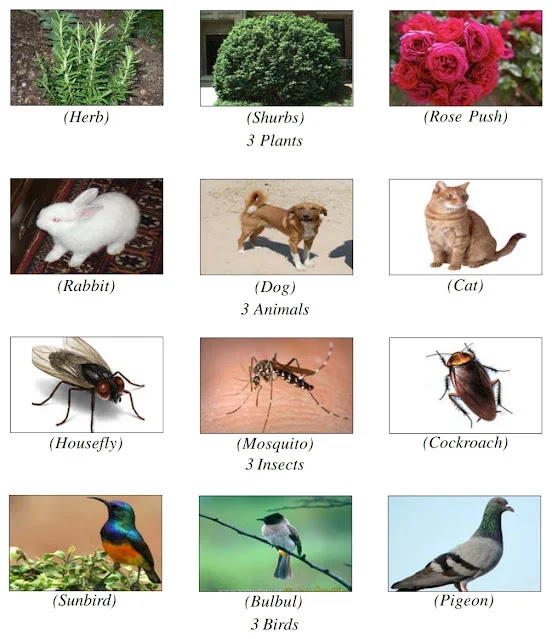
Aim:- SURVEY OF VEGETATION, BIRDS, INSECTS AND OTHER ANIMALS IN AN AREA.
We, the human beings share our living space with a wide variety of plants and animals. All of them contribute towards making our environment healthy and enjoyable. It is important to learn about them as they are our valuable companions.
Objectives
After performing this exercise, you will be able to:
- appreciate bio-diversity;
- identify some plants, birds, insects and animals.

Method
- Observe common plants, birds, insects and other animals as you walk around to go somewhere or your place of work. You may even specially visit a park / forest / hill / pond in your neighborhood for this purpose. Prepare a file and scrap book with photographs / pictures / drawings / pressed or collected specimens of atleast 3 plants (herbs, shrubs, trees), 3 birds, 3 insects and 3 other animals. You may record your observations in a format as suggest below or in any other way that you wish to observations.
Exercise – 4
Aim:- CHOOSE FIVE COMMON SPECIES OF TREES / PLANTS FROM YOUR NEIGHBORHOOD AND LIST THEIR COMMON NAMES. DESCRIBE EACH PLANT IN TERMS OF ITS HEIGHT AND LEAVES.
Plants constitute one of the most obvious components of our environment. Different types of plants are seen in our surrounding such as trees- large plants with stout trunks that stand freely, shrubs-bushy plants of medium height with branching close to the base and herbs- small plants with soft stems, usually found in a specific season. Even in a highly built up area one can find tiny plants in the form of mosses, grass and other small weeds. Ornamental and other potted plants can even be found indoors. Study of these plants/trees helps us in understanding the biodiversity in plant kingdom and in appreciating its significance.
Objectives
After performing this exercise, you will be able to:
- enlist various plants available in the area;
- point out the important features of the plants of the area;
- identify each plant on the bases of its height, the shape of stem and the shape of leaves;
- appreciate plant biodiversity.
What You Should Know
- The distinction between the herbs, the shrubs and the trees.
- The techniques of measuring the height of the trees.
- The common names of the most common trees of the area.
- The tracing technique: Put a leaf under a white sheet of paper or a sheet in your
- notebook. Hold it in place as shown in fig

Hold you pencil tip sideways and rub it on the portion of the paper having the leaf below it. (Remember to take soft pencil for this purpose) These lines on the leaves are called veins. Observe the venation. It may be parallel or reticulate (optional).
Material Required


How To Proceed
(i) Select an area suitable for your field work. It may be your school campus or your locality or any other place inhabited by a good number of plants.
(ii) Select any one plant. Write its common name.
(iii) Observe the parts of the plant carefully.
(iv) Take a leaf print and a print of its bark.
(v) Measure the height of the plant. For measuring the height of a tall tree you can use any one of the following methods.
%20Practical%20File%20in%20Hindi%20Medium.webp)

%20Practical%20File%20in%20English%20Medium.webp)
%20Practical%20File%20in%20English%20Medium.webp&description=NIOS Class 12th Environmental Science (333) Solved Practical File English Medium 2022-23)
0 Comments